There is a particular moment every homeowner recognizes. You walk past the guest bathroom, catch something foul in the air, and immediately blame the trash can. You empty it. The smell stays. You bleach the toilet, light a candle, crack the window. By Thursday it is back, and now it has crept into the hallway.
We get this call a lot at Blue Grid Plumbing, usually from someone who has already spent two weekends and forty dollars on air fresheners. Here is the part that surprises people: a sewer smell in bathroom spaces is almost never a cleaning problem. It is a pressure and sealing problem. Something in your drain, waste, and vent system (plumbers call it the DWV system) has stopped doing its one job, which is keeping the air inside your pipes separate from the air inside your home.
That distinction matters, because you cannot scrub your way out of a broken seal. You can only find it and fix it.
What You Are Actually Breathing When the Bathroom Smells Like Sewage
Sewer gas is not one gas. It is a blend produced by anaerobic bacteria breaking down organic waste inside your drain lines and the municipal sewer. The headline compound is hydrogen sulfide, and it is responsible for the rotten egg note everyone recognizes. Alongside it you get methane, ammonia, carbon dioxide, and trace mercaptans, which are the same family of sulfur compounds utilities deliberately add to natural gas so leaks smell like something.
Your nose is remarkably good at catching hydrogen sulfide. The Agency for Toxic Substances and Disease Registry puts the human detection range somewhere between 0.0005 and 0.3 parts per million, which is a fraction of a fraction. That sensitivity is a gift, and it is also a trap, because the warning system fails exactly when you need it most. Olfactory fatigue sets in with continued exposure, so odor stops being a reliable gauge of how much gas is actually present. Hydrogen sulfide is also slightly heavier than air, which means it settles into low spots, floor cavities, and crawl spaces rather than dispersing on its own.
Approximate concentration |
What people typically report |
|
0.0005 to 0.3 ppm |
Odor first becomes noticeable |
|
2 to 5 ppm |
Headache, nausea, watering eyes, airway tightening in some people with asthma |
|
20 ppm |
Fatigue, dizziness, poor concentration, appetite loss |
|
50 to 100 ppm |
Eye inflammation and upper respiratory irritation after roughly an hour |
|
Above 100 ppm |
Sense of smell shuts down entirely, which is the dangerous part |
Those thresholds come from OSHA and ATSDR exposure guidance. Household concentrations rarely climb into the upper rows of that table. Still, a bathroom that smells like sewer gas every single day is telling you a seal has failed somewhere, and seals that fail tend to keep failing worse.
Four faults account for the overwhelming majority of what we find on service calls across Sunnyvale, Santa Clara, and San Jose. Let me walk you through each one the way I would explain it standing in your bathroom.
Cause One: A Dry P-Trap, and Why the Guest Bathroom Is Always the Guilty Party
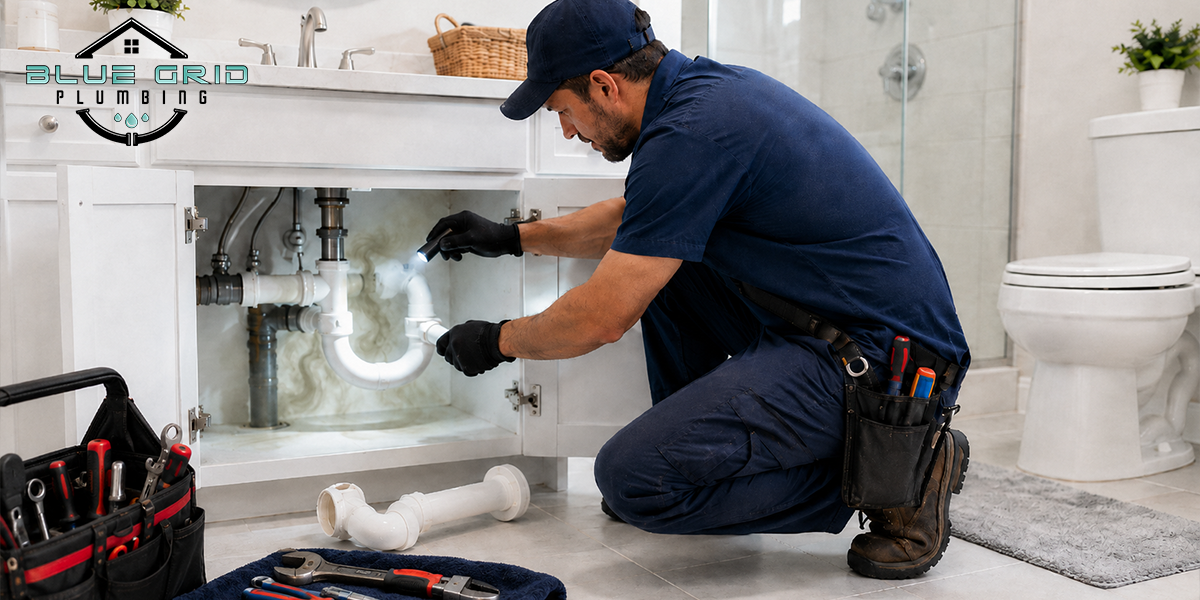
Look under your bathroom sink. That U-shaped bend of pipe is a P-trap, and it works on an idea so simple it feels like cheating. It holds a small plug of standing water. Sewer gas rising up the drain line hits that water and stops.
Plumbing code takes this seriously. Under the Uniform Plumbing Code that governs work here in California, every fixture trap must hold a liquid seal of at least 2 inches and no more than 4 inches. That is your entire barrier between the bathroom and the sewer. A few cups of water.
Water evaporates. In a bathroom nobody uses, a lavatory trap can go dry in under a month, and shower and floor drain traps follow the same clock. Add dry indoor air and a bathroom that only sees action when your in-laws visit, and you have the single most common source of bathroom drain smells we encounter.
The tell is unmistakable once you know it. The odor concentrates near one specific drain, it is worst in a room that has been sitting unused, and it clears within minutes of running water. If that describes your situation, the fix costs nothing. Run each fixture for a full sixty seconds and flush the toilet. Wait ten minutes. If the smell lifts, you found it.
If the smell comes back within a day or two, the trap is not evaporating. Something is pulling it out, and that points you toward cause number three.
Cause Two: A Failed Wax Ring or a Closet Flange Sitting Too Low
Your toilet does not sit on the floor. It sits on a closet flange, and a wax ring compresses between the two to form a gas-tight seal against the drain opening. When that compression fails, sewer gas escapes at floor level, around the base of the bowl, continuously.
Wax rings are not immortal. They dry out, crack, and lose their memory over decades. Movement kills them faster. A toilet that rocks even slightly when you sit down grinds the wax out of position with every use.
Installation errors cause just as many failures as age does. A closet flange set below the finished floor instead of on top of it cannot generate proper compression against the wax, and an installer who crushes the wax too hard on one side leaves a channel on the other for gas to escape. This is why a bathroom remodel where somebody tiled over the old floor without adjusting the flange height can start smelling six months later.
Diagnose this one by paying attention to geography and timing. Wax ring odor sits low, near the toilet base, and it does not respond at all to running water in the other fixtures. Look for flooring around the base that feels soft or discolored, since a compromised seal usually lets small amounts of water escape alongside the gas, quietly damaging the subfloor.
Resetting a toilet properly means pulling the fixture, inspecting the flange for cracks or corrosion, correcting the height with an extender ring if needed, and setting fresh wax. Our toilet and fixture repair team handles this as a same-visit repair in most homes, and the flange inspection is the step homeowners tend to skip when they attempt it themselves.
Cause Three: A Blocked, Cracked, or Undersized Vent
This is the cause people never guess, and it is the one that explains why a smell keeps returning after you have fixed everything else.
Every drain in your home needs air behind the water it discharges. That air arrives through vent pipes running up through your walls and out the roof. Without it, a column of draining water acts like a siphon and pulls the trap seal out of a nearby fixture, a phenomenon plumbers call self-siphonage. The venting system is designed to hold pressure variation inside the drain lines within roughly one inch of water column in either direction, because a standard trap seal cannot survive much more than that.
Vents fail three ways. They get blocked at the roof terminal by leaves, debris, or a bird nest. They crack inside a wall cavity, releasing gas directly into framing where it seeps out around baseboards and outlets. Or they were run too far from the fixture in the first place, which is a code violation that shows up constantly in unpermitted remodels.
That last one has hard numbers attached. The maximum horizontal distance from a trap weir to the inner edge of its vent is set by pipe diameter.
Trap arm diameter |
Minimum distance to vent |
Maximum distance to vent |
|
1-1/4 inch |
2-1/2 inches |
30 inches |
|
1-1/2 inch |
3 inches |
42 inches |
|
2 inch |
4 inches |
5 feet |
|
3 inch |
6 inches |
6 feet |
|
4 inch and larger |
8 inches |
10 feet |
Those figures come from Uniform Plumbing Code Table 1002.2, which also caps a water closet at 6 feet measured from the top of the closet flange to the vent. Run a trap arm longer than its limit and the fixture will siphon itself dry on a regular basis, no matter how many times you refill it.
Venting problems announce themselves with sound before smell. Gurgling drains after a flush, odor spread across multiple rooms rather than concentrated at one fixture, and traps that keep going dry all point at the vent stack. Diagnosis means roof access and often a smoke test, where we introduce non-toxic visible smoke into the drain system and watch where it escapes. That is the fastest way to locate a cracked vent hidden inside a wall, and it is one of the reasons a proper diagnostic visit beats guesswork.
Cause Four: Biofilm in the Drain, or Damage Further Down the Lateral
The fourth cause splits into a mild version and a serious one.
The mild version is biofilm. Hair, soap scum, skin cells, and toothpaste build a slick anaerobic colony along the inside walls of your drain and up under the toilet rim. Sulfate-reducing bacteria living in that layer produce hydrogen sulfide right there on site. The trap is intact, the wax ring is fine, the vent is clear, and the bathroom still smells because the source is eighteen inches inside the pipe. Biofilm odor gets stronger with hot water and worse in shower drains, and sluggish drainage often shows up before the smell ever does. Mechanical cleaning solves it. Chemical drain cleaners mostly do not, because they cut a narrow channel through the blockage without stripping the pipe wall. Our drain cleaning services address this properly with cabling or hydro jetting depending on the line.
The serious version is a compromised sewer lateral, the private line running from your house to the city main. Root intrusion, ground movement, offset joints, and simple age crack these lines, and older neighborhoods across Santa Clara County have plenty of clay and cast iron still in service. When a lateral cracks, gas escapes into the soil under your slab and finds its way up through utility penetrations and expansion joints. The smell reads as diffuse and almost outdoor adjacent rather than tied to any one fixture, and it frequently arrives alongside recurring backups.
Confirming this requires a video camera inspection of the line, which is standard practice before anyone quotes a repair. If you want a realistic sense of what that repair involves financially, our breakdown of sewer line repair costs in San Jose covers trenchless versus open-cut approaches and what drives the price in either direction. Our San Jose sewer service crew handles inspection, cleaning, and repair on the same visit where the scope allows.
One Look-Alike Worth Ruling Out First
Before you chase any of the four, check where the smell lives.
If the rotten egg odor only appears when you run hot water, and it follows the hot tap to the kitchen and the laundry too, your drains are innocent. That signature belongs to sulfate-reducing bacteria inside the water heater tank, reacting with a magnesium anode rod. It is a water quality issue, not a sewer gas issue, and the fix involves flushing the tank and usually swapping to an aluminium or powered anode rather than touching a single drain.
Water heaters are talkative appliances in general, and homeowners often catch a second symptom without connecting it. If yours has been popping, rumbling, or screeching lately, our guide to what each water heater noise actually means will tell you whether sediment has been building in the tank, which is frequently the same condition feeding the odor.
A Fifteen Minute Diagnostic You Can Run Before Calling Anyone
Work through this in order. Each step rules something out.
-
Run water into every fixture in the bathroom for sixty seconds each, including the tub and the shower, then flush the toilet twice. Wait ten minutes. If the odor clears, a dry trap was your answer and the case is closed.
-
Push gently on the toilet bowl with the heel of your hand. Any rocking, however slight, implicates the wax ring. Check the floor around the base for softness or staining while you are down there.
-
Listen when you flush and when you drain a full sink. Gurgling, glugging, or a toilet bowl whose water level visibly drops afterward points at the vent.
-
Sniff at the drain openings directly, then again at floor level. Drain-centered odor suggests biofilm. Floor-level odor near the toilet suggests the wax seal. Odor that seems to come from nowhere in particular suggests the vent or the lateral.
-
Walk the rest of the house. If a second bathroom or the laundry area smells too, stop diagnosing and call a professional. Multi-room odor means the fault sits upstream of individual fixtures.
Ventilate the room while you work through this. Run the exhaust fan and open a window.
When to Stop Troubleshooting and Pick Up the Phone
Refilling a dry trap is homeowner territory. Almost nothing else on this list is, and the reason is not liability language. Pulling a toilet without knowing the flange condition, climbing onto a roof to probe a vent stack, or pouring acid down a line you have never inspected all create the possibility of turning a smell into a repair.
Call a licensed plumber when the odor survives a full flush of every fixture, when it affects more than one room, when drains gurgle or run slow throughout the house, when water backs up into a tub or shower, or when you notice soft flooring anywhere near a toilet. If the smell arrived suddenly and came with a backup, treat it as urgent, and our guide to what counts as a plumbing emergency will help you decide whether it can wait until Monday.
Blue Grid Plumbing works throughout Sunnyvale, Santa Clara, San Jose, Milpitas, Campbell, Los Gatos, Saratoga, Cupertino, and Mountain View under California license 1153156. If your bathroom has been smelling like sewage for more than a few days, tell us what you are smelling and where and we will tell you what it usually turns out to be. Half the diagnosis happens over the phone
.
Keeping the Smell From Coming Back
Three habits prevent most repeat calls. Run water in every seldom-used fixture once a week, which takes about ninety seconds for an entire guest bathroom and permanently solves the evaporation problem. Fit strainers over shower and sink drains so hair never gets a chance to seed a biofilm colony. Have your vent terminations and your lateral looked at every few years, particularly if you have mature trees within twenty feet of the sewer run.
A bathroom that smells like sewer gas is a warning, not a nuisance. Homes tell you when a seal has failed. This one just happens to tell you loudly.
Frequently Asked Questions
Is a sewer smell in the bathroom dangerous?
At the concentrations found in most homes, sewer gas is unpleasant rather than acutely harmful, though it commonly causes headaches, nausea, and eye irritation with sustained exposure. The real concern is what the odor represents. Hydrogen sulfide deadens your sense of smell as levels rise, so odor alone is a poor gauge of severity. Ventilate the space and get the source identified rather than masking it.
Why does my bathroom smell like sewage only at night or in the morning?
Intermittent odor usually points at pressure changes rather than a constant leak. Cooler overnight temperatures and reduced water use let trap seals settle and, in homes with marginal venting, allow gas to push past a partially depleted seal. It can also mean a trap that is siphoning slowly and refilling each time you use the fixture.
Can I just pour bleach down the drain to fix it?
Bleach masks odor for a few hours and does very little to biofilm, which sits under a protective matrix that chlorine struggles to penetrate. It also degrades some pipe seals and gaskets over time. Mechanical cleaning removes the source; chemicals move it around.
How long does a toilet wax ring last?
Most wax rings run twenty to thirty years under normal conditions. They fail much sooner when the toilet rocks, when the closet flange sits below the finished floor, or when the fixture was overtightened during installation.
My bathroom smells like sewer but all the drains are wet. What now?
Full traps rule out evaporation, which moves you to the wax ring, the vent, or biofilm. Check the toilet for movement first, then listen for gurgling. If neither shows anything, the odor is most likely coming from inside the drain wall or from a vent fault that needs professional diagnosis.
Do air admittance valves cause sewer smells?
They can. An air admittance valve is a one-way mechanical vent used where running a pipe to the roof is impractical. The internal seal degrades over time, and a failed AAV lets gas straight into the cabinet it is mounted in. They are not permitted for every application under the California Plumbing Code, so an AAV installed in the wrong location is worth having checked.
How much does it cost to fix a sewer smell?
It depends entirely on the cause. Refilling a dry trap costs nothing. Drain cleaning and toilet resets sit in the low hundreds. Vent repairs and sewer lateral work vary widely with access and length of run, which is why we inspect before quoting rather than after.